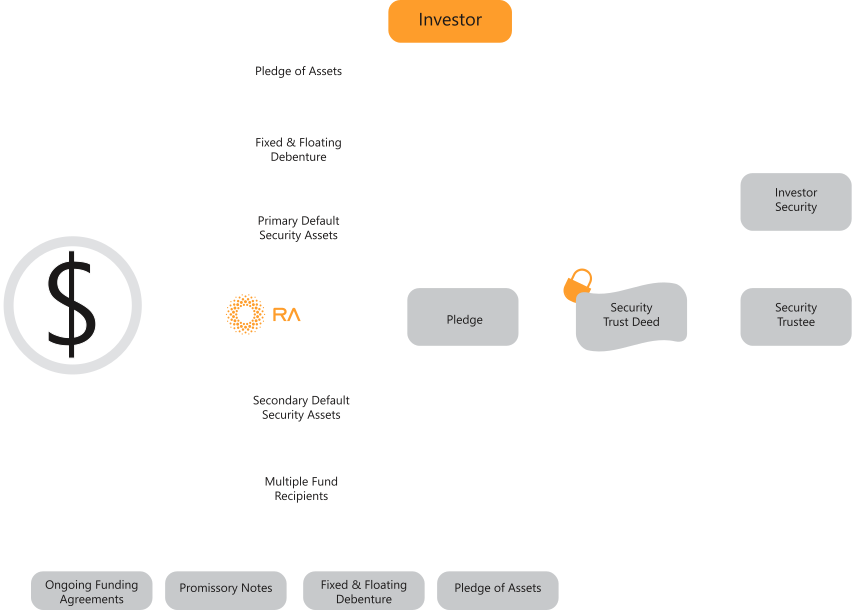
It is important for the Bondholder to distinguish between the 2 transactions, and although the answer to both is quite similar, there exists a further level of security in relation to the transaction between the Bondholders and RA-ESG:
Transaction 1: The Bond issued by RA-ESG to the Bondholder.
Transaction 2: The investment of the proceeds from the Bond subscriptions into the Fund Recipients by RA-ESG.
Transaction 1 – Bondholder Security In Respect Of The Issuer
In terms of the ‘Proceeds of Funds’ obligations entered into by RA-ESG, the Issuer is required to apply the funds emanating from subscriptions to the Bonds consistent with the Investment Memorandum, and in doing so shall generate substantial assets owned by RA-ESG. All assets of RA-ESG generated by such funding including but not limited to;
The intellectual property and regulatory licences,
The contracted supply of energy (kWhs) sold under a PPA (Power Purchase Agreement),
All land and acquired real estate,
All hardware, software, patents, Intellectual property, plant and equipment,
The right, title and benefit to all and any brand names and logotypes,
The right, title and benefit to all and any third-party equity or debt agreements (to include all Promissory Notes),
All goodwill and client data, debtors’ books, client accounts and Power Purchase Agreements,
A pledge 100% (one hundred percent) of RA-ESG’s issued share capital
And all and any other assets owned by RA-ESG shall form a portfolio of assets (referred to as ‘Default Security Assets’). The Default Security Assets shall form a full and unrestricted cession in security in respect of all Outstanding Bonds that are secured pursuant to the Security Trust Deed, held by the Security Trustee for the benefit of the Bondholders. This ensures that in the event of an unremedied Event of Default, Bondholders hold a senior secured debt position and first charge over all of the assets of the company and are preferred over shareholders or other creditors. For further information on Bondholder protection, please see: Bond Security and the Security Trustee Clause 19.4 of the Agreement.
Transaction 2 – RA-ESG Security In Respect Of Fund Recipients
As discussed earlier in this document a large part of RA-ESG’s investment strategy is entering into Joint Venture, Equity or Debt positions with companies within the Sustainable Energy sector. In the instance of joint venture or equity investments, RA-ESG will hold stock/shares in those respective companies that will be pledged to the Bondholders as part of the Secondary Default Assets. However, in the case of debt securities this would not normally be the case. Therefore, to ensure an ongoing and unbroken chain of security from Fund Receipt to Bondholder RA-ESG collects the following signed documentation from each company that receives funds in the form of a debt security:
An Ongoing Fund Agreement containing a pledge of 100% of the assets of the Fund Recipient.
A transferable Promissory Note in respect of each tranche of funds placed with the Fund Recipient.
A Fixed and Floating Debenture / First Charge held against the Fund Recipient.
All three of the above documents are then pledged to the Security Trustee to hold for and on behalf of the Bondholders until the Redemption of their Bonds.
BUSINESS MODEL RISKS
RA-ESG evaluates its Business Model risk on three levels:
STRATEGIC RISK
RA-ESG makes its corporate investments in diverse geographic locations and multiple product streams so as to mitigate any geographic or product-specific anomaly. RA-ESG’s investment and trading strategy includes trading in multiple countries, products and applications, this diversifies many risk issues; regional-specific peaks and troughs are mitigated due to production coming from other regions within the network.
RA-ESG may invest in rural energy generation programmes, by their nature this requires the placement of plant and equipment in impoverished communities, where crime and corruption can be an issue. Sometimes theft (or even destruction due to superstition) can cause financial loss, and although security systems and insurance coverage can help to alleviate losses, this does not mean RA-ESG would always experience a positive ROI in such cases. Where possible, and in all facilities over 1MW, RA-ESG insists upon an SBLC or BG (Standy Letter of Credit or Bank Guarantee) from an Investment Grade Bank or Financial Institution to underwrite the Facility.
Almost all risk in investment is “financial” in nature; however, the specific risks referred to hereunder are onward and down-chain financial risks associated with the Business Model and transactions processed in terms of it, namely:
• Fraud by third-party Fund Recipients. – All Fund Recipients are strictly vetted in terms of KYC (Know Your Client) and AML (Anti-Money Laundering) processes as well as third-party identity checks, fraud, insolvency and bankruptcy checks. In addition, the Consultative Committee investigates, analyses and evaluates each Fund Recipient, but it cannot be precluded that an act of fraud could take place.
Funding a brighter, sustainable energy future that reaches every corner of the world. Together, we can power meaningful change and support the transition to cleaner, smarter energy.