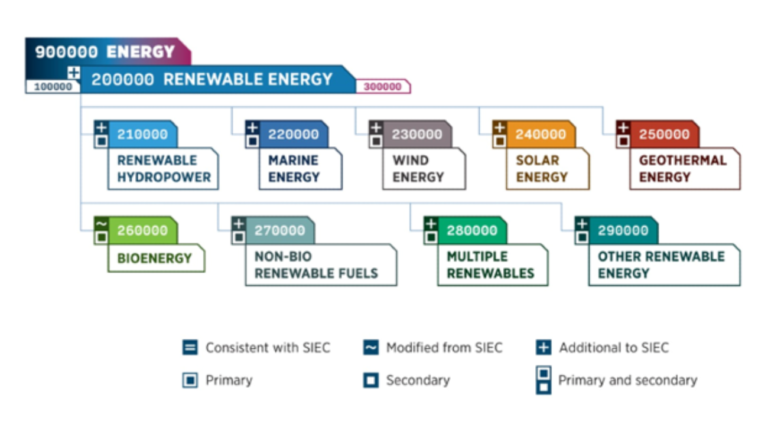
The energy systems today are more complex than ever. Countries are using more renewable energy solutions to move away from fossil fuels as the main source of energy in many contexts. This is good news for a cleaner and more sustainable energy future. But as the shift takes place, a few issues emerge in keeping track of the energy sources.
One of the issues is that the rules that are currently used to track energy worldwide published in the International Recommendations for Energy Statistics (IRES) do not explicitly state the difference between renewable and non-renewable energy sources. Among the missing pieces are the multiple kinds of renewable energy technologies and products that are becoming more widely used at present.
Because the standard international energy product classifications (SIEC) were published almost 15 years ago, there is a need to update them using a more detailed renewable energy taxonomy. Otherwise, the travel of energy transition will be guided by outdated maps.
Having a clear approach to classify energy sources is not only important for tracking and measuring, but also to make sense of the ongoing energy transition. On top of that, as proposed by IRES, a common framework for energy categories can be of immense help for countries to collaborate since they speak to each other in a common language.
From the energy transition’s perspective, the classification of energy should start with the question “is it renewable?”. Knowing the difference will be paramount for energy statisticians and analysts to easily understand if the energy system of a country is becoming more sustainable over time, or to better assess the energy sources by how much they would impact the climate.
Renewable energy is not analogous to climate change, but it is a key aspect in climate adaptation and mitigation. Since the Paris Agreement established an international carbon accounting framework for energy, many countries have successfully translated their domestic energy information into a common international measure of carbon emissions to the atmosphere.
Today, countries have abandoned old data series or opt out from tracking certain energy sources because they fall under other government organisation’s authority, due to lack of funding and political interest, or because there are no set rules to track certain energy options like off-grid technologies or some forms of bioenergy. Indeed, the global energy information could benefit from a more defined and comprehensive energy taxonomy.
By showing clear divisions of what is renewable and what is not, countries and analysts would more easily understand the carbon emitted by each energy sub-sector, providing more suitable local recommendations that meet the countries’ needs to speed up their energy transitions.
To that end, the International Renewable Energy Agency (IRENA) prepared a new system to classify the different energy sources that would serve as a new map to travel through the intricacies of the energy transitions. The IRENA taxonomy leaves out electricity and heat, but proposes a way to fit hydrogen and ammonia in the energy sources. While this may not make immediate sense because these molecules are the same regardless of their sources, they are differentiated between renewable and non-renewable sources. In fact, this method is common already with electricity and heat, with the fraction that comes from renewable sources implicitly denoted.
Implementing such taxonomy will require a lot of work, which includes re-categorising and adjusting of historical data and more international collaboration. But innovation drives technological change, and with it, comes new ways to group energy. Harmonising data across countries and time will bring more clarity to the complex and dynamic energy sector, enabling countries to navigate energy discussions more effectively, with better and more detailed information that would unlock insightful and life-changing decisions. There is no alternative but continuing to refine and update this work as international discussions arise.
Read more about IRENA’s new Energy taxonomy here.